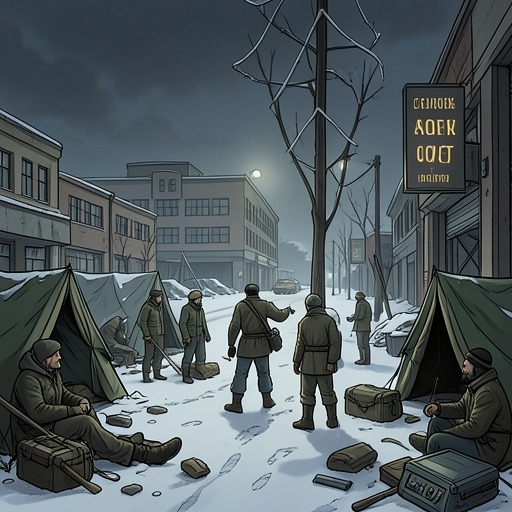
The founding of the Museum of Civilization
Station ElevenThe founding of the Museum of Civilization is Clark Thompson’s first deliberate act of preservation in the stranded community at Severn City Airport. He begins with a glass case that once held sandwiches, placing inside it objects whose former uses have largely disappeared. The small collection becomes a shared museum, preserving not only things but the human labor, connections, and memories that those things once carried.
The Airport and the Lost World
The museum takes shape in a place built for movement that has become a settlement. In the old world, passengers looked down from airplanes at illuminated towns and crossed borders in a matter of hours; after the collapse, aircraft stand dormant on runways and in hangars, sometimes used to store food. Severn City Airport, where Clark and other travelers have been stranded, thus holds the visible remains of a transport system that no longer works as it did.
The loss is also informational. Television channels have dwindled to static, test patterns, or emergency broadcasts, and the Internet has gone dark. The screens and devices that once connected people to distant lives now remain as material objects, detached from the networks that gave them reach. This rupture supplies the museum with its central problem: how to preserve a world that its inhabitants once experienced through technologies they scarcely had to notice.
Clark Begins the Collection
Clark enters the Skymiles Lounge because it is quiet and offers a view of the tarmac. He has been avoiding Elizabeth, and looking out at the line of planes brings Robert to mind. Robert had been a curator; Clark imagines that, if present, he would fill the lounge’s empty display case with artifacts and begin a museum. Clark then places his own useless iPhone on the case’s top shelf.
He adds two belongings left behind at the airport: Max’s American Express card and Lily Patterson’s driver’s licence, which had been set beside the card on the counter of the Mexican restaurant in Concourse B. The objects seem insubstantial in the case, so Clark adds his laptop. He tells no one that he has begun a museum. When he returns a few hours later, someone has contributed another iPhone, red high-heeled shoes, and a snow globe. Those additions make the collection communal before it has an official name or announced purpose.
Objects as Human Histories
Clark’s response to the objects reaches beyond nostalgia for their former utility. In his state of mind, he finds beauty in all of them because each represents human enterprise. The snow globe prompts him to imagine the chain of work behind it: its design, the manufacture of its plastic flakes, assembly in China, packing, a ship crossing the ocean, and delivery to the airport. The globe is a small, ordinary object, but its making depended on a far-reaching network of people, tools, and transport.
The case therefore preserves more than a selection of vanished consumer goods. It gives physical form to the interdependence that the collapsed infrastructure once concealed. When Clark shakes the globe and sees the grounded planes distorted behind its swirling snow, the object briefly gathers the lost world into a single frame: a miniature landscape, the airport’s immobilized aircraft, and the global chain that brought the globe there.
From Founding Gesture to Museum
The initial display develops into a substantial collection. By the end of Year Fifteen, about three hundred people live at the airport, and the Museum of Civilization fills the Skymiles Lounge. Clark, older and no longer needed for survival work every day, can devote his time to the museum. Its holdings include phones, iPads, laptops, Tyler’s Nintendo console, impractical shoes, polished car engines, and a chrome motorcycle, alongside newspapers, magazines, stamps, coins, passports, driver’s licences, and credit cards. Clark keeps careful records, including records of people who lived at the airport and later died.
The objects acquire different meanings for the people who visit. James, who found the motorcycle in Severn City and used it until fuel was no longer available, comes to see it almost daily; Emmanuelle, the first child born at the airport, often looks at the phones. Visitors can also sit in former First-Class lounge chairs and read old newspapers with brittle pages, using gloves Clark has sewn from a hotel sheet. The museum’s displays and routines turn looking at the past into a regular part of life in the settlement.
Inheritance and Significance
The museum becomes part of how the airport teaches its children about a world beyond their direct experience. In the school at Concourse C, pupils learn that airplanes once crossed the world, that electronic devices once connected to a worldwide network, and that goods traveled by ship and plane. They can understand a map’s dots for places such as Severn City, Chicago, and Detroit more readily than the borders that once divided countries. The museum’s objects make some of those abstractions tangible, even as the children’s questions reveal how much of the old system cannot be restored through explanation alone.
The founding gesture is modest: Clark places an unusable phone in an empty case, then watches others add their own remnants. Its consequence is larger. The museum makes preservation a collective practice and gives stranded residents a setting in which loss can be approached through particular objects rather than through an impossible attempt to reconstruct the entire vanished world.